This is a great piece from Kickdefella. He wrote a lengthy essay to explain the truth about fuel subsidy. I am reproducing his essay here which was written in Bahasa Melayu after translating it into English. My sincerest apology in advance if I did a bad translation job.
Last night, Hassan Marican appeared on National Television willingly to bare all about Petronas. Unfortunately, the only answer he should have given last night to those stupid panels (and moderator) was “Bloody hell, what a stupid question! Go and **PAKLAH** yourself la!” but he remained calm though.
Most probably the instruction was to grill him as though the increase of fuel prices is all Petronas faults.
Meanwhile, Last week, before leaving for Dubai, Dato’ Husam Musa called for a Press Conference to reveal all the facts and to justify his claim that it is not necessary for the government to increase fuel prices. It is also to give his insights on how actually it is possible to reduce the fuel prices.
Unfortunately, none of it ever came out in the mainstream papers although we have about 30 journalist and broadcaster packing the small office. The TVPAS reporter came ten minutes later and arrogantly left the room because the session already started. As a result, the session goes unrecorded. It was a total blackout on what was said and PAS official organ too play a role in it.
I have written in this blog all the facts and have published the figures to justify the claim where many are more interested to use rhetoric and to show the slimy strength by demonstrating and cause misery to the already much affected taxi drivers and shoppers in KL.
To some politicians, it is easier to get your photos and story published in newspaper by behaving like hooligans in public places yet when you got the chance to speak up, only buckets of nonsense do come out.
Today I will continue with my essay and we will discuss how it is possible to reduce the price of fuel prices and to put a stop in the already escalating cost of living.
Government Has Not Been Truthful Regarding the Fuel Subsidy
The government claimed that it would spend close to RM40 billion (I read somewhere it is RM56 billion??) this year for fuel subsidy. This is actually a lie, or an attempt by the government to mislead the people.
The facts are:
• Government does not come up with any cost, even one cent for fuel subsidy.
• Fuel subsidy is not included in government’s expenditure
• There is no actually no fuel subsidy. Zilch. Nil.
• The government only spends money for toll subsidy, public transportation subsidy, food subsidy and other subsidies not for fuel subsidy.
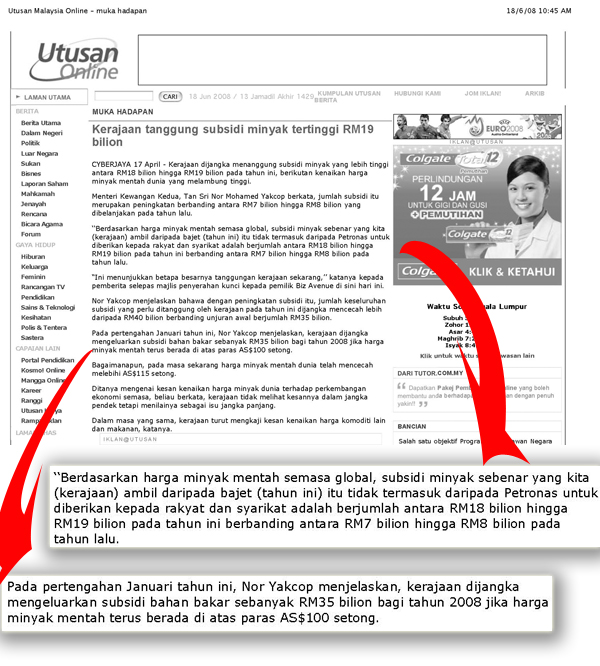
Because of that, the following statement by the Second Finance Minister Nor Mohamed Yakcop is not accurate and intended to mislead the people.
(click on photo for bigger image)
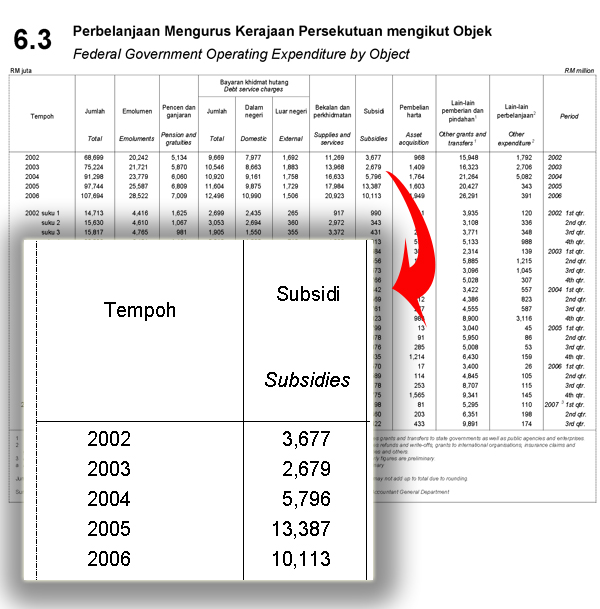
Data provided by Treasury Malaysia clearly not as mentioned by the Second Finance Minister, Cabinet Ministers, Abdullah Ahmad Badawi and also Khairy Jamaluddin during Umno General Assembly 2007.
Data from the Treasury show the following information:
(click on photo for bigger image)
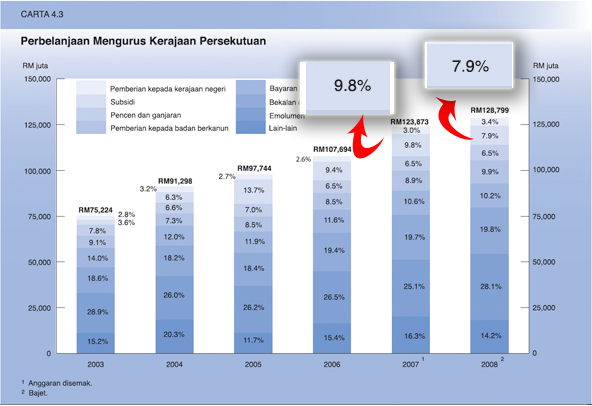
According to the Treasury Report in Table 6.3, Federal Government Operating Expenditure, total subsidies spent in 2007 is RM12.1 billion which is 9.8% from RM124 billion government operating expenditure. In 2008, total subsidies is predicted to be RM10.1 billion or 7.8% from the total RM129 billion government operation expenditure allocation that was approved in 2008 Budget.
(click on photo for bigger image)
This clearly shows that expenditure to manage fuel subsidy is never included in government expenditure because:
• Operating expenditure data by Treasury shows a lesser amount and obviously not sufficient to sustain the total subsidies which allegedly estimated at RM40 billion.
• Total fuel subsidy is not included in other data inside government’s account as recorded in Treasury’s
Annual Report.
So, where the subsidy comes from? The fuel subsidy actually never exists. Fuel for domestic use is obtained through:
• Crude oil exchange mechanism.
• 400k barrels of higher grade crude oil ‘Tapis Blend’ – highest crude oil grade will be exchanged in global market with domestic crude oil demand.
• This crude oil after being processed into petrol and diesel is sold to people at price determined by the government.
• The government gets net profit (because the government never spends anything) from the tax paid by petroleum companies, petrol stations and other suppliers.
Is it true Malaysia’s crude oil reserves will last in another few years?
Lately, the people were told that Malaysia’s crude oil reserves won’t last much longer and this country will be a net importer of oil. This is used by the government to justify the increase of fuel prices and cut ‘fuel subsidy’ to prepare the people with market price when the country starts to import oil for domestic use.
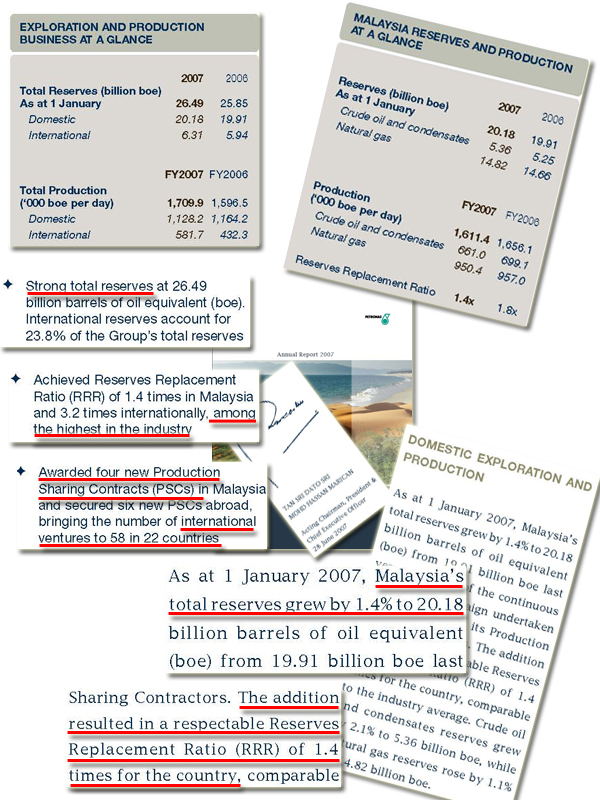
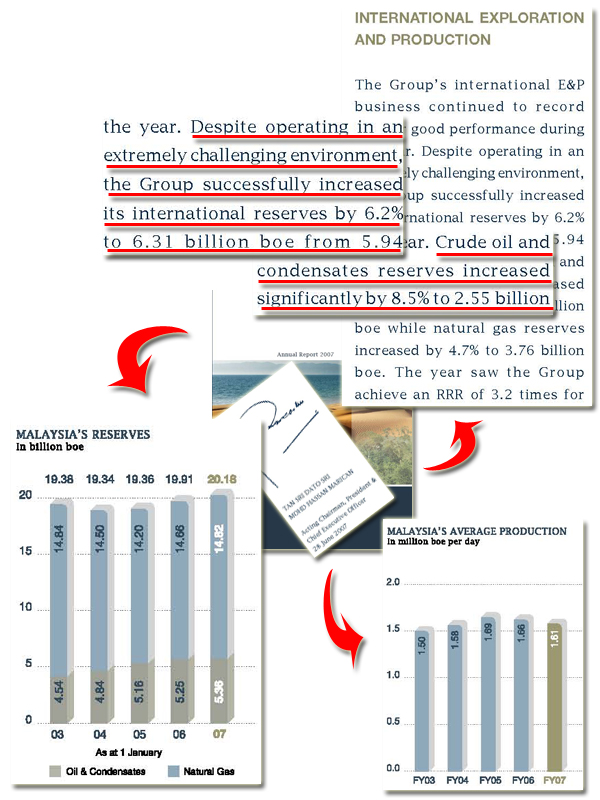
However, Petronas 2006 Annual Report recorded that Malaysia’s crude oil reserves can last until 2024.
(click on photo for bigger image)
Hassan Marican, Acting chairman, President and Chief Executive Officer of Petronas meanwhile explained to the media that in 2011, Malaysia will become net importer of oil because the domestic demand will exceed the country’s crude oil output. This means that domestic demand for crude oil will be more than 700k barrels per day. But this is in 2011 and coming, the country will still able to produce 700k barrels of crude oil per day, which he never refuted.
According to Petronas Annual Report since 1980, Malaysia’s crude oil reserves is increasing and not decreasing. In 1980, it was reported Malaysia’s crude oil reserves stand at 3 billion barrels, and since then we had produce more than 4 billion barrels and up to now, we still produce around 650k to 200k barrels per day for 365 days and this at this rate we can last for another 20 years.
The fact is that this country’s crude oil reserves are increasing and not decreasing. In 2008, we have crude oil reserves estimated at 4 billion barrels and Malaysia is placed at number 28th among countries in the world with largest oil reserves.
(click on photo for bigger image)
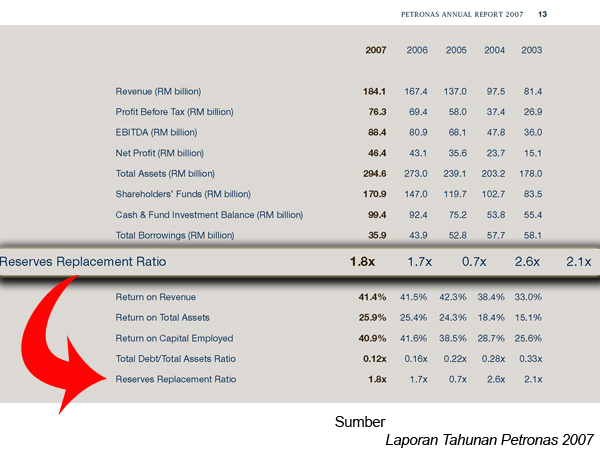
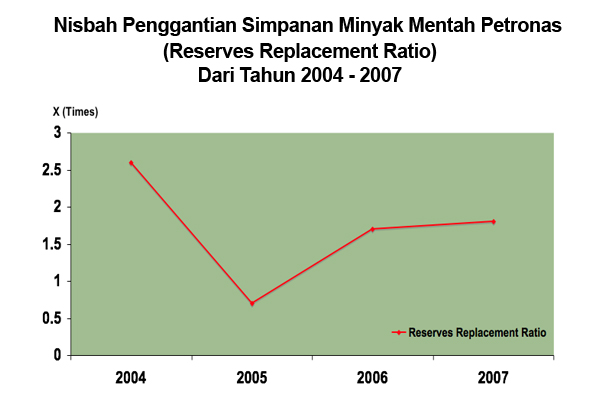
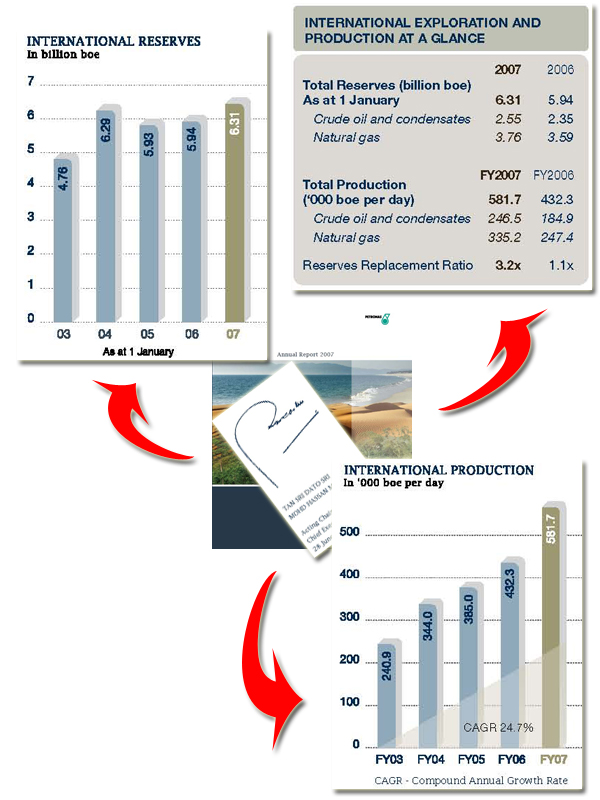
Malaysia’s crude oil reserves will not finish so soon. This is because Petronas, a petroleum company owned by the rakyat invest hundreds of million every year for oil exploration all over the world. From the investment, we found new reserves and according to the same report, the reserves replacement ratio currently is 1:1.8 liter. This translated as, for very 1 liter used, Petronas found 1.8 liter new reserves. This means the replacement rate is higher than the usage rate.
(click on photo for bigger image)
Fuel Price Reduction Is Not Impossible
To optimise profit from crude oil, the government does not have to increase fuel price. The government actually can optimise its profit by reducing the fuel price at the same time.
Reducing the Usage of Petrol and Diesel
Fuel price in Malaysia is the highest among oil producing countries. Based on population of 26 million and crude oil output rate at 650k-700k barrels per day, Malaysia has a very high output ratio but this has not benefited its population which is far lower than the rest of the oil producers.
Petrol and diesel priced should be reduced and this is possibly done. Among the measures to reduce the price are:
Changing from petrol and diesel usage to natural gas for cars or NGV (Natural Gas Vehicles) should be done because of these factors:
• Malaysia is the 13th largest natural gas reserves country in the world. In 2004, Dato’ Mustapha Mohamed announced that Malaysia’s natural gas reserves is estimated at around 89 trillion cubic feet.
• The government encourages the usage of NGV because it is cleaner and environmental friendly but never make it compulsory for every petrol station to provide this service. As a result, there are limited number of NGV stations and mostly only available in Klang Valley.
• Wide usage of NGV by vehicles will reduce the demands for petrol and diesel.
• Malaysia can sell more crude oil and this will bring more profit to the country.
• Price of petrol and diesel can be further reduced using this extra profit
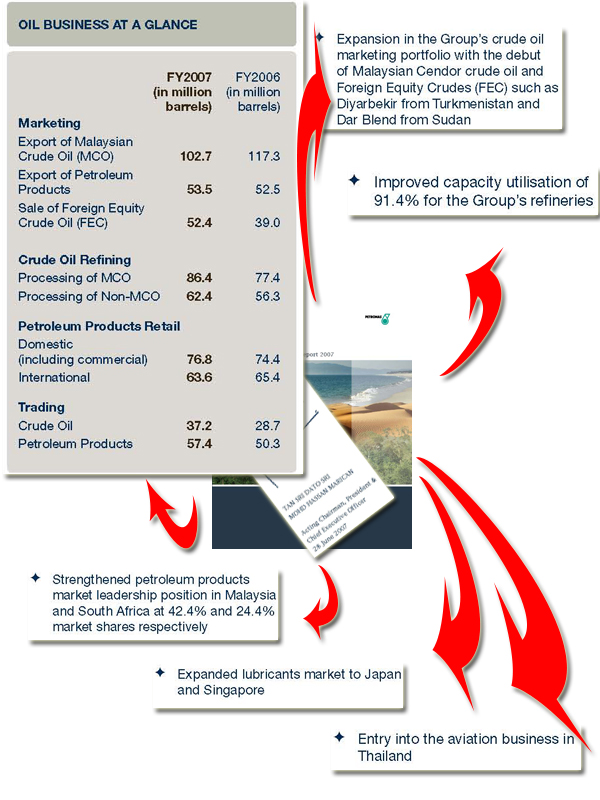
National Petroleum Advisory Council
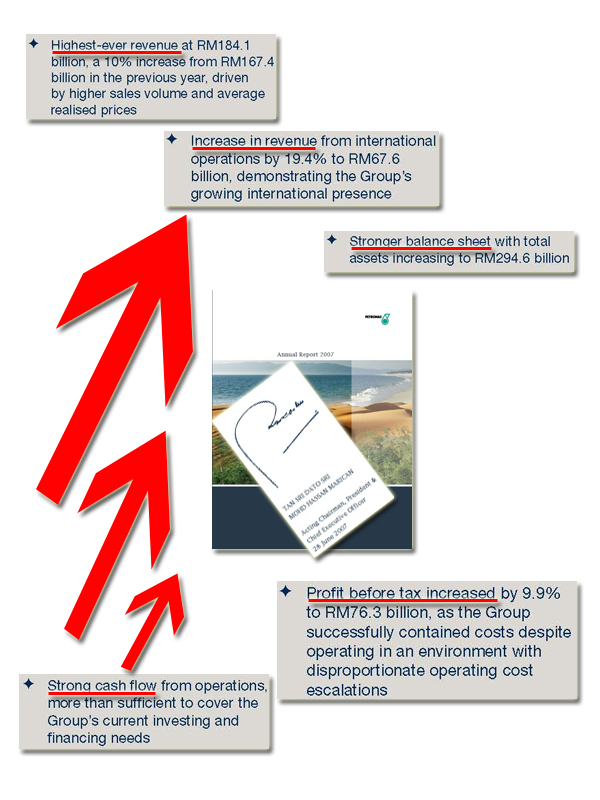
National Petroleum Advisory Council (NPAC) should be formed again to gather experts that will involve in planning the energy usage and shaping efficient energy policies for the country. NPAC was formed together with Petronas before but it does no longer exist now.
(click on photo for bigger image)
Petronas reaps high profit each year. As a company that is tasked to manage the national treasure owned by the people of Malaysia, Petronas organisation structure should focus on guarding the people’s interest. It is important NPAC to be revived, by choosing credible candidates and not for the sake of ‘political selection’. In other words, revival of NPAC means nothing if it is used to for political mileage by ‘expired’ UMNO politicians such as Abdul Rahim Thamby Chik or Zainuddin Maidin.
Check and Balance in Petronas
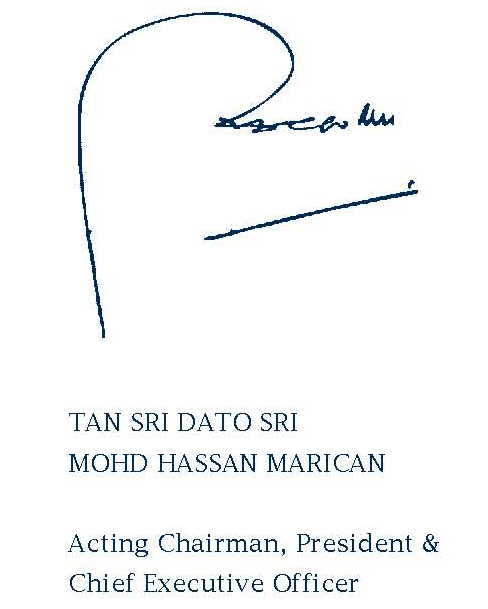
Currently, Tan Sri Dato’ Mohd. Hassan Merican holds the three highest posts in Petronas – Acting chairman, President and Chief Executive Officer. Before this, two of these positions were held by different individuals.
(click on photo for bigger image)
Without trying to discredit the achievements and success brought by Tan Sri Dato’ Seri Mohd. Hassan Marican since helming Petronas, by holding to these three positions, Tan Sri Dato’ Seri Mohd. Hassan Marican becomes too powerful and this hampers check and balance inside Petronas and affects the transparency in managing Petronas.
Conclusion
People should enjoy the benefits of prosperity from the global oil price increase. As a net exporter of crude oil, the oil price increase should be translated as an additional income to the country.
Unfortunately, not only people cannot reap the benefits from the country resources, people are burdened with the fuel price increase which generated ripple effects to the price of consumer items.
Based on the arguments and data provided, it proven that the government decision to increase the fuel price is baseless.
This is the proof of poor planning and management under the government of Prime Minister Abdullah Ahmad Badawi. People should insist for their rights to enjoy benefits as an oil producing country and call the government to reduce the fuel price. If this is not carried out, the country’s economy will decline and people will suffer not only the direct consequences but also need to face the social problems arise from it.
Give Back the People’s Rights Now! 


 ) Air is fresh. I can sleep well at night without hearing Mat
  I just found out, there are not many choices of food served and if you go to the canteen for lunch slightly later than 12.45pm you need to scrap whatever leftover there and there is only one operator there. Monopoly. Never good for consumers.
 Doesn’t it annoy you to the max when you are given the menu and when you order your food, this doesn’t have, that is not available.. bla bla??

 You know it is true when you read something like this:
 Right
Right 


 Find your buyers here. Scrap metal now is around RM300- RM400 per tonne now. Go do your own calculation. Find your buyers