Palm oil jumped 154 points. The curve is the interesting part.
Palm oil had its best session in months on Wednesday. January 2027 jumped 154 points to settle at 4,410, after six sessions of sliding. By Thursday evening it was 4,448, and suddenly everybody had an opinion again.
People keep asking me whether palm oil is going up or down. I keep telling them the number on the screen is the least useful thing this week. The curve is where the story is.
What the curve is saying
Thursday’s board: November 4,168, December 4,298, January 4,448, February 4,566, March 4,662, April 4,728, May 4,756.
Every month further out on this stretch costs more. The fancy word is contango. It is not a simple price forecast. Think rent, with other things in the bill.
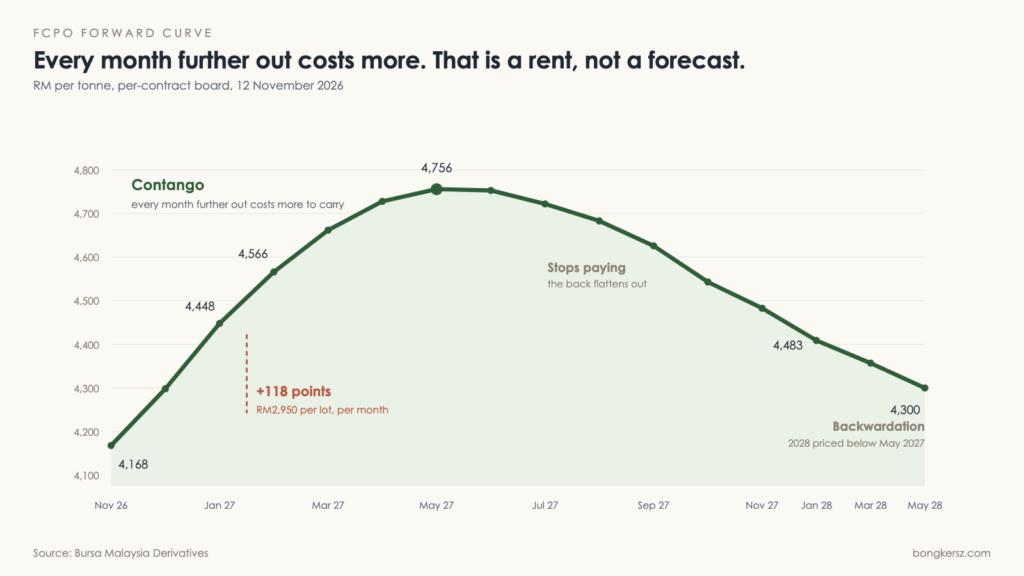
The FCPO curve, 12 November 2026. Rising through May 2027, then easing further out.
Somebody has to keep the oil somewhere. Tanks, insurance, financing, the whole business of holding a few thousand tonnes of oil without it spoiling or walking away. Those carrying costs help shape the curve, alongside seasonal supply, demand and the value of having oil available now. January to February is 118 points apart: RM118 a tonne, or RM2,950 per lot on 25 tonnes. That is the quoted price gap between two delivery months, not a storage invoice.
Why it is that steep
October stocks were 3.62 million tonnes. Record, and the seventh straight build. Production 2.15 million tonnes, also a record. Plenty of oil can weigh on nearby prices and make storage matter more. Gudang penuh is the picture, lah.
But the spread alone cannot tell us that tanks are literally full, or how much of those 118 points is warehousing.
A steep curve bleeds a rolling long while the spreads stay put and the front fails to rise: each roll sells a cheaper month and buys a dearer one, and that carry only comes back if the front catches up. But the roll itself does not create a profit or loss equal to the spread. A long sells January and buys February higher; a short buys January back and sells February higher. Neither pockets nor pays RM2,950 just for pressing those buttons. Actual profit depends on entry and exit prices, how prices and spreads move, and trading costs. Nor is 118 points a fixed monthly charge. The next spread can be a different animal.
The other thing I look at is the front. November futures 4,168. Physical November in the south 4,170. Near par, though location, quality and delivery terms matter. A shortage can put a premium on prompt supply and push the curve into backwardation. These quotes suggest little urgency for nearby oil. They do not prove every buyer has all the oil they need.
Where this gets dangerous
None of this means the curve is wrong, or proves the trade is crowded. SPPOMA had production down 26 per cent in the first ten days of November. That could be the seasonal turn arriving early and hard, though ten days is not a full month or the whole industry. If stocks really do start falling, the cheap month can stop being cheap and everybody short the front finds out why it was cheap. When the curve flips, the front can move fastest. I agree with the short and I still would not marry it.
The pasar malam version
Still confused? Think durian season.
Today’s durian cheap. Next month’s durian expensive. The cold room helps explain the gap, but so do the next harvest and who wants to eat. Palm oil sama. Rent is a useful picture, not the whole price list.
And short January, roll to February? Higher selling price, yes. 118 points masuk pocket for free? No lah. You have closed one bet and opened another. If the front tightens and you are on the wrong side, still can kena. That is why we do not marry the position.
November expires on Friday the 13th, under the 15th-or-preceding-business-day rule. Fitting, for a market that has spent a week deciding nothing.
I am not telling anyone what to trade. I am saying that if you read the settle alone, you are reading one sentence out of a paragraph. The curve tells you what the market is paying to avoid, and right now it is paying a lot to avoid holding palm oil.
Not a call. Just a price list.