
The haze, oil palm and the question of who really started the fire
I have written on this before but for an online publication called The Belian Post in 2019. The site is no longer available, but am still keeping my 2019 draft. I have recently updated the draft with more details since there are more regulations and requirements put in place by the government, authorities and relevant departments. I have also changed the tone of my writing to a more… ‘informal’ way.
It’s that time of the year again, when the noonday sun dims, mountains and buildings disappear behind a curtain of grey, and that familiar smell of smoke follows you around wherever you go.
The haze is back!
For those of us living in this part of Southeast Asia, especially in Borneo, this has become an almost seasonal affair. During prolonged dry periods, fires appear across Sumatra and Kalimantan and, depending on where the wind decides to blow, the smoke eventually finds its way across borders.
We have been dealing with this for decades. The 1997 haze remains probably the most memorable, when the Air Pollutant Index (API) in Kuching went beyond an astounding 800. I was in Form 3 back then taking my PMR. Sarawak declared a 10-day state of emergency on September 19, 1997 because the API reading was over 500. I think in Miri it was close to over 900, visibility was really poor. I was staying at the hostel back then and I remember walking to the dining hall and could not see like 5m-10m distance ahead.
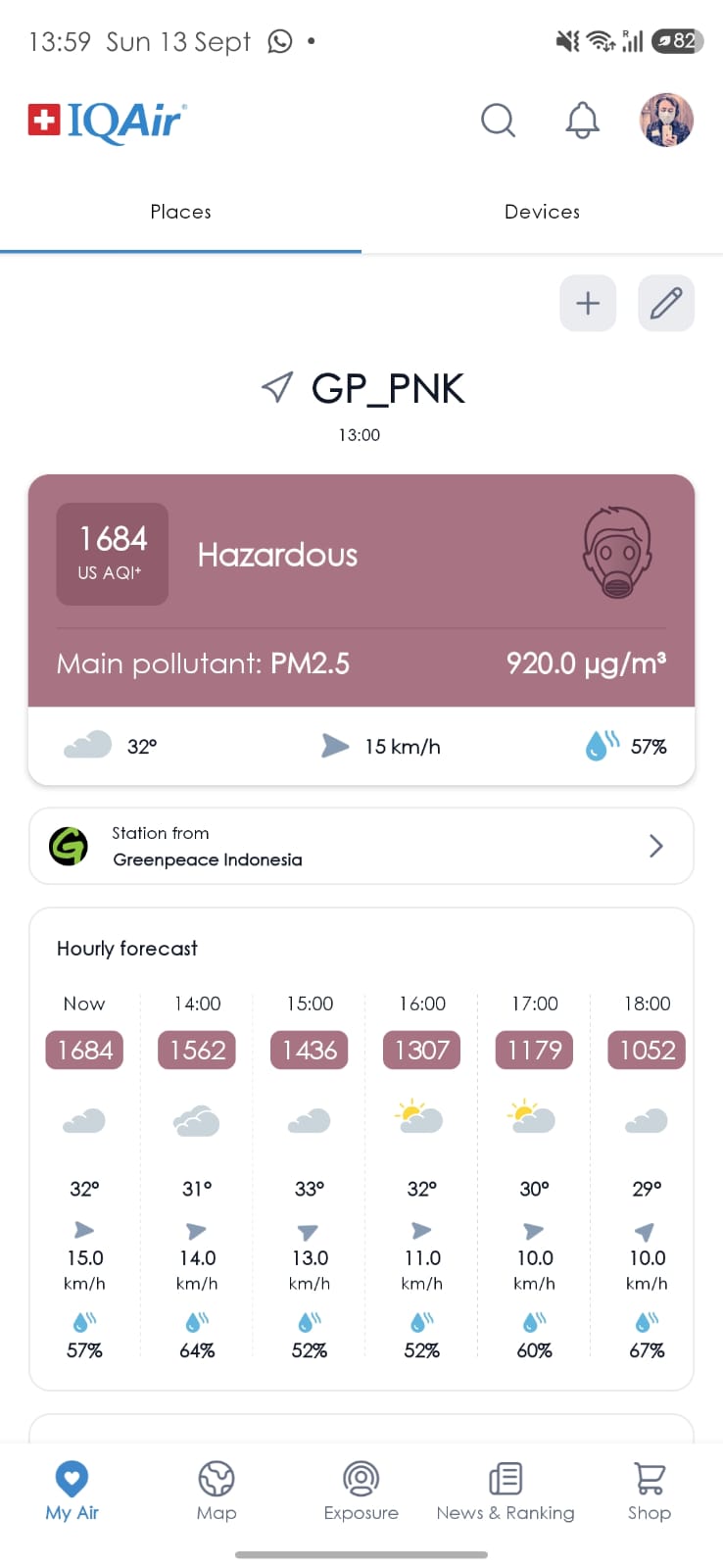
Then we had few more notable periods of serious haze like in 2013, 2015 and 2019 when I wrote the article because it got so bad as well I remember. 2015 and 2019 was bad, I think it was El Niño season as well in 2015. Anyway, since then we have had several serious episodes, schools closed, flights disrupted, visibility reduced and millions of people breathing air that they really should not be breathing and of course this year with the what El Niño “Godzilla”, by far this year is among the worst, on par or even worse than 1997 episode. In Pontianak, last Sunday and Monday I think the reading was 1,500 – 1,900 from the AirVisual app.
And every time the haze comes back, so does the same explanation.
It must be the oil palm plantations.
Those big plantation companies are burning thousands of hectares to clear the land again.
Why doesn’t the Indonesian government do something about them?
I work in the plantation industry, so perhaps I look at this differently from someone looking at a hotspot map from outside. I have seen what actually happens inside plantations during the dry season, how fires are dealt with on the ground, how complicated the ownership of land within and around plantation areas can be, and just how much manpower and equipment can be involved when somebody reports smoke somewhere.
That does not mean plantation companies are innocent. Some have undoubtedly been involved in illegal burning and where that is proven, they should be dealt with accordingly.
But the idea that the transboundary haze can simply be explained as “big oil palm companies burning forests” has always bothered me because the reality on the ground is far more complicated than that.
First, finding a hotspot is not the same as finding who started the fire
Satellite technology today is remarkably good. We can detect hotspots across Sumatra and Kalimantan almost in real time, plot them on a map and overlay them against plantation boundaries.
This is extremely useful.
The problem starts when we make the next jump.
Hotspot inside plantation concession = plantation company started the fire.
That is not necessarily true.
Anyone who has actually worked around large plantation areas in Indonesia will know that the neat boundaries we see on a map do not necessarily describe what exists on the ground.
Inside and around plantation landscapes you can have villages, community land, independent farmers, conservation areas and land with competing or unresolved claims. You can have people cultivating land independently even though, when you look at a concession map from a few hundred kilometres away, everything appears to sit inside one giant polygon belonging to Company A.
Then there is the obvious fact that fire does not understand cadastral boundaries. A fire that starts on somebody’s farm does not stop at the boundary marker, check the map and decide that the next piece of land belongs to somebody else.
So satellite hotspots are very good at telling us where something is burning. They are not necessarily capable of telling us who lit it.
That second question requires investigation on the ground.
There is, however, another side to this argument which plantation companies themselves cannot conveniently ignore. Even if somebody else started the fire, that does not necessarily end the company’s responsibility.
Who started the fire and who was responsible for detecting, preventing and controlling the fire are two different questions. This distinction is important, and under Indonesia’s latest regulations it has become even more important.
Why would a plantation burn its own trees anyway?
Slash-and-burn agriculture has existed for centuries for one very obvious reason: it is cheap. Cut the vegetation, let it dry and burn it.
Compare that with bringing in excavators, bulldozers, tractors, trucks and workers to mechanically clear the same piece of land and you can understand why a farmer with very little capital might choose fire. Commercial plantations historically used burning as well. Nobody needs to pretend otherwise. But the economics and practicalities of managing a modern commercial oil palm plantation are quite different.
Oil palm is a long-term crop. You plant it, wait roughly three years before meaningful commercial production begins and then manage the same palms for around two decades before replanting becomes necessary. You are not clearing and replanting the entire estate every few years.
When replanting does come, simply burning everything is not particularly useful.
You still have to establish planting rows and planting points. Roads need to remain accessible. Drains need to function. Old palm biomass needs to be dealt with. Soil and water conditions need to be managed. All of this is much easier to control, measure and supervise mechanically. More importantly, fire is unpredictable. And evidently it is HARD to control or else we would not have the problem we face today.
An uncontrolled fire does not politely burn the old palms you want removed and then extinguish itself when it reaches the next block. It can jump roads and drains, damage palms you intended to keep and, during very dry weather, get completely out of control. From a plantation manager’s point of view, this is not merely an environmental problem. It can become an operational and financial disaster.
And today there is another very important consideration: plantation land opening and cultivation without burning is no longer merely a matter of good agricultural practice. It is regulated.
The HGU problem
Another thing that is frequently misunderstood outside Indonesia is Hak Guna Usaha, or HGU.
HGU is a legal right to cultivate land under Indonesia’s agrarian framework, originating from Law No. 5 of 1960 concerning Basic Agrarian Principles (UUPA). On paper, an HGU or plantation licence can cover an enormous area. On the ground, things are rarely so tidy.
There may be villages, community land, independent farmers, conservation areas and unresolved land claims within and around the wider plantation landscape. Plantation companies normally try to consolidate economically viable areas through land acquisition or cooperation arrangements such as plasma schemes (sort of like co-operative, farmer-owned by local organisation that partners with a large plantation company to manage a portion of community agricultural land, most commonly in the Indonesian palm oil sector), but not everybody wants to participate.
Some farmers prefer to manage their own land. Some distrust plantation companies. Some claims existed long before the plantation arrived. Others remain disputed for years.
It can be messy.
This is why looking at a hotspot and saying “that is inside Company X’s area, therefore Company X started the fire” is not enough to establish what actually happened. But again, this does not mean Company X can wash its hands of the matter. And this is where things have changed considerably since I first wrote about this issue.
Indonesia has tightened the rules considerably
Indonesia introduced Minister of Agriculture Regulation No. 06 of 2025 (Permentan No. 06 Tahun 2025), amending the earlier 2018 regulation governing plantation land opening and cultivation without burning. If you go through the regulation, some of the requirements are surprisingly specific.
This is not merely a document telling plantation companies that they should have some pumps lying around somewhere in case something catches fire. Plantation companies are required to establish a proper fire-control organisation with manpower, equipment, detection systems and operational procedures. The number of dedicated core firefighters is tied directly to plantation size.
For an operation of 1,001 to 5,000 hectares, there must be two core teams totalling 30 personnel. From 5,001 to 10,000 hectares, it becomes three teams totalling 45 personnel. A plantation between 10,001 and 20,000 hectares must maintain four core teams with 60 personnel.
Yes. It is a law and mandated for the plantation companies to set it in such a way. A 15,000-hectare plantation is expected to have 60 core firefighting personnel. Firefighting is no longer something the manager can delegate to five security guards and a water tanker when somebody sees smoke.
The requirements go further.
For oil palm, there must be one fire observation tower for every 250 to 600 hectares, subject to adjustments for the topography of the estate. The observation floor has to be at least three metres above the highest crop canopy. Usually they just put up a 15m and above observation tower, made from steel structure at a minimum 1 unit every 600 hectares. The local authorities would come and inspect and count how many observation towers already been built against the requirement. Modern technology is specifically recognised as well. Monitoring can involve CCTV, real-time remote sensing and hotspot information, while drones or binoculars form part of the monitoring equipment.
Then you have the actual firefighting equipment.
Protective clothing, helmets, masks, gloves and firefighting boots. Axes, fire beaters, rakes, shovels, backpack pumps and chainsaws. High-pressure pumps, portable pumps, hoses, nozzles and water tanks. GPS units, handheld radios and vehicles or boats depending on the terrain.
There is even specific equipment for injecting water into burning peat — suntikan gambut — because anyone who has dealt with peat fires knows that putting out the flames you can see is sometimes the easy part.
The fire underneath your feet is another matter altogether.
Water availability is regulated too. Plantation companies are required to provide one or more water-storage facilities for every 500 hectares, with a combined minimum capacity of 800 cubic metres. Estates have to allocate machinery to dig up ponds with storage capacity more than 800 cubic metres, every 500 hectares. Well during the long period of extreme dry season like the current El Niño “Godzilla”, most of the ponds dried up anyway.
These are measurable requirements. We can therefore judge a plantation not merely by whether it claims somebody else started the fire, but by whether it was actually prepared to deal with one.
Was the fire detected quickly?
Were the towers operational?
Were the firefighting teams properly staffed?
Were the pumps working?
Was sufficient water available?
How quickly did the team reach the site?
If its own resources could not control the fire, did it call for assistance?
This is a much more useful way of determining corporate responsibility.
Then we have the smallholders
Now imagine a farmer with two hectares of land.
He wants to plant paddy, vegetables, fruit trees or perhaps oil palm. He has a parang, some basic tools and his own labour.
He does not have an excavator.
Mechanical clearing costs money. Fire costs almost nothing.
The economics are obvious.
One farmer burning one hectare is not going to cover half of Southeast Asia in smoke. But if many people are preparing land during the same dry period, many individually small fires become a much larger problem. And there is a specific regulation allowing local farmers to clear their land by burning – 2 hectares per household. Look it up, Google it yourself which province allows that.
Then add peat into the equation.
And this is where things can go very wrong, very quickly.
Peat changes everything
Healthy peat is naturally wet. In that condition it is relatively difficult to burn.
Drain it, lower the water table and then subject it to a prolonged dry period, and you have something completely different. You have fuel. A vegetation fire at the surface can ignite the dry peat underneath. The visible flames may eventually disappear and everyone thinks the fire is under control. Except that the ground is still burning. And during this extreme dry season, without proper water management in the peat area, the area will be dried out and prone to fire. Just a passerby, motorist or hunter in the jungle discarding or flicking a cigarette butt, still hot or not fully extinguished would spark a fire.
Peat can smoulder below the surface for days or longer, moving through the organic material and appearing somewhere else. Fighting it is extremely difficult because you are no longer merely trying to extinguish burning vegetation. You are effectively trying to extinguish burning soil. This is also where assigning responsibility becomes uncomfortable.
Imagine that a farmer starts a fire outside a plantation and the fire eventually reaches drained peat within a developed area.
Who caused the resulting haze? The farmer who struck the match? The company whose drainage system contributed to drying the peat? The authority that approved the development? The people responsible for enforcing the regulations? The landholder who failed to respond quickly enough?
Potentially, several of them contributed to the outcome in different ways. Which is why I think we spend too much time asking who started the fire, when another equally important question is:
Why was the landscape capable of burning like this in the first place?
“We didn’t start it” is not enough either
This is one aspect of the 2025 regulation that is particularly important. If a fire occurs within the plantation area covered by the company’s business licence, the plantation company is required to undertake firefighting. If the company cannot control it with its own resources, it has to coordinate with government brigades, community fire groups, Manggala Agni, local fire departments or firefighting units belonging to other plantation companies.
In other words, saying “not our fire” is not sufficient.
You may not have lit it, but if it is burning inside your operational area you are still expected to do something about it.
That is fair.
Large companies have resources. They have people, equipment, vehicles, roads, pumps, management structures and increasingly sophisticated monitoring systems. If a company deliberately burns land illegally, prosecute it. If it is required to maintain 60 firefighters and does not, deal with it. If its fire towers exist only in inspection reports but not in the field, deal with it. If the pumps do not work, the water ponds are dry and nobody responds to a hotspot until hundreds of hectares are burning, then “somebody else started it” is not much of a defence.
Corporate responsibility should be enforced properly. In Malaysia, we even tried to come up with a transboundary haze law in 2019. The new Pakatan Harapan government at that time considered introducing a Transboundary Haze Pollution Act (similar to Singapore’s 2014 law) to penalise Malaysian companies contributing to smoke-causing fires abroad, or specifically in Indonesia. However idiots from the tebuk-atap government took over and the Enviromnent Minister at that time, that PAS fler Tuan Ibrahim put it on hold cancelled it. You can read more about the haze act chronology here.
And actually, the more difficult problem is what to do with everybody else.
You cannot give every farmer an excavator
This is where environmental policy runs into economic reality. Tell a plantation company managing 15,000 hectares that it cannot use fire and must purchase equipment, build water ponds, maintain observation towers and employ firefighting teams. Fine. It has the financial and organisational capacity to do that.
Now tell a farmer working two hectares that he cannot burn the vegetation on his land. His immediate question will probably be: Okay, so who is paying for the excavator? But this does not mean smallholders should be allowed to burn indiscriminately. Smoke does not become less harmful because the person who produced it is poor.
But simply banning something without providing an economically viable alternative does not make the underlying incentive disappear. Interestingly, Indonesia’s new regulatory framework appears to recognise this problem as well. The regulation provides for Kelompok Tani Peduli Api (KTPA), or Farmer Fire Awareness Groups, consisting of a trained farmer as leader together with 15 to 30 trained farmers. These groups are supposed to help educate farmers about land preparation without burning, monitor hotspots, conduct early firefighting and coordinate with government and other firefighting organisations.
In theory, you begin to get several layers of defence: plantation firefighting teams, community KTPA groups, government brigades, Manggala Agni and other emergency services.
Whether all of this works equally well everywhere on the ground is another question altogether, like usual lah.
A regulation is only as useful as its implementation.
And then there is politics
This is probably the most difficult part of the problem.
Smallholders are not corporations. Many have limited financial resources. Some communities have used controlled burning as part of their agricultural practices for generations. Land ownership itself may be disputed. Alternatives can be expensive.
And, of course, these communities vote.They protest. If you are stopping their way of life, their culture of doing things you need to provide the alternatives and solutions. Actually I think they need more incentives – the carrot, to not to burn rather than giving them the stick.
Governments cannot ignore illegal burning simply because the people doing it are poor. At the same time, marching into rural communities every dry season and treating a subsistence farmer in exactly the same way as a company illegally clearing hundreds of hectares is hardly a sensible solution either.
There has to be something in between.
Shared machinery. Especially during the dry season when nearby farmers or communities are clearing lands to plant their crops, the large companies – plantations, mining, pulp, instead of asking them to spend money and allocate resources for the fire fighting and monitoring which usually already “after the effect”, maybe should look into offering their resources and machinery during this period. The government and authorities can incentivise them to do so, for sure. Community land-clearing programmes. Financial assistance. Training. Properly equipped village firefighting teams. Better land records. Peat restoration. Practical alternatives that make not burning economically possible and attractive to all.
Otherwise we will continue dealing with the symptom while leaving the incentive untouched.
So who is responsible for the haze?
I think this is where the whole argument normally goes wrong.
We want one answer.
The plantation companies did it.
The smallholders did it.
Indonesia did it.
El Niño did it.
Pick your villain.
The reality is considerably less satisfying. There are really several questions that need to be answered separately.
Who started the fire?
Who benefited from the burning?
Why was the land so combustible?
Why did the fire spread?
And who was responsible for controlling it once it did?
The answers may not point to the same person.
A farmer can start a fire. A commercial interest can start a fire. A badly managed drainage system can make peat dangerously dry. Drought can magnify everything. Poor enforcement can allow illegal practices to continue. Inadequate firefighting can allow a manageable fire to become an uncontrollable one.
Then the wind blows. Suddenly something that started on a few hectares of land in Kalimantan or Sumatra becomes everybody’s problem. That, I think, is the more useful way of understanding transboundary haze. It is not simply an oil palm problem. Neither is it simply a smallholder problem. It is a land management, peatland, agricultural economics, enforcement and governance problem, all interacting with each other during the worst possible time of the year.
Large plantation companies are actually the easier part of this equation. We know who they are. We know where they operate. Indonesia now has measurable requirements for the number of firefighters, observation towers, equipment and water they are supposed to maintain.
Enforce those requirements properly. The much harder task is building the same level of fire resilience across thousands of independent farmers and communities who do not have corporate resources behind them. And that cannot be solved by fines and jail sentences alone.
So the next time the mountains disappear and that familiar smell of smoke starts creeping into the house, by all means ask:
Who started the fire?
We should find out.
But perhaps after decades of going through the same thing, we should also be asking a bigger question.
Why do we still have landscapes where one fire can become an international environmental disaster?
Because whoever held the match is only the beginning of the story. Everything that allowed that small flame to become thousands of hectares of fire and millions of people breathing the smoke is the real problem. And until we fix that, we will probably continue doing what we have been doing for decades.
Wait for the rain, lah!